
Makharij al-Huruf
Click a letter and see where it comes from — seventeen articulation points across five regions.
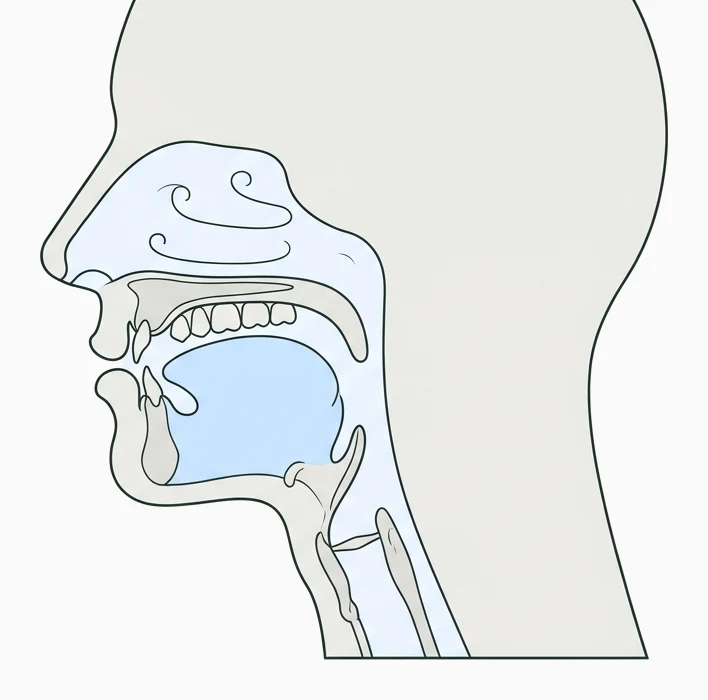
Five letters from the lips to the depth of the throat, each makhraj lighting up on the section.
Start wherever you like
Click a letter in the strip below the diagram and its makhraj lights up on the section, with the description beside it.
Pick one of the five regions — the oral cavity, the throat, the tongue, the lips or the nasal cavity — to see the makharij and letters it holds.
Click a position on the section directly, or switch to “the seventeen makharij” to see all of them at once.
The five regions
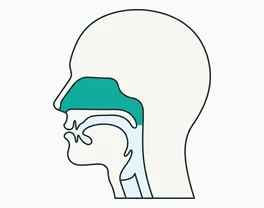 The nasal cavity
The seat of the ghunnah — a nasal resonance that always accompanies nun and mim, and is fullest when either is doubled.
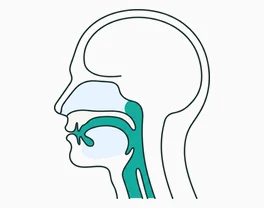 The throat
Three makharij — the deepest, the middle and the nearest part of the throat — producing six letters.
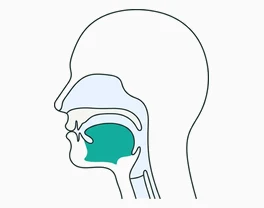 The tongue
By far the largest region: ten makharij accounting for eighteen of the letters.
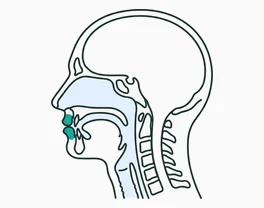 The two lips
Two makharij: the inside of the lower lip against the upper incisor tips for fa, and the two lips together for ba, mim and waw.
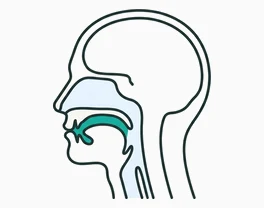 The oral cavity
The empty column of air running from the depth of the throat to the mouth. The three letters of madd come from it.
Frequently asked questions
How many makharij are there?
Seventeen, following Ibn al-Jazari — the position most curricula teach. Other scholars counted differently: fourteen for al-Farra’ and Qutrub, sixteen for Sibawayh and al-Shatibi. The disagreement is about the oral cavity and the letters of madd, not about the rest of the letters.
What are the five regions?
The oral cavity (one makhraj, for the letters of madd), the throat (three makharij, six letters), the tongue (ten makharij, eighteen letters), the two lips (two makharij, four letters) and the nasal cavity (one makhraj, for the ghunnah).
Why do waw and ya appear at more than one point?
Because their makhraj follows how they are voiced: as letters of madd they come from the oral cavity, while a voiced waw comes from the lips and a voiced ya from the middle of the tongue. The tool flags this when you select either one.
What is the difference between a makhraj and a sifah?
The makhraj is where a letter is produced. The sifah is how it is produced from there — voiced or voiceless, plosive or continuant, raised or lowered, and so on. This tool covers makharij only: two letters can share a makhraj and differ entirely in sifah, as ta and ta do.
Is the tool free?
Yes. It runs in the browser with no install and no sign-up, and you can export the diagram as an image to use in a lesson or a handout.
Our other free tools
All free, in the browser, no account.
Write Arabic from any device by typing in Latin letters.
The Arabic alphabetAll 28 letters, their 4 forms and the harakat, with a printable PDF.
Add the harakatAdd the vowels back to undiacritized Arabic, in your browser.
Fix reversed Arabic textRepair Arabic from Photoshop or a PDF: reversed order, disconnected letters.
Decorate Arabic textGeometric and floral ornament for your name or bio, ready to copy.
Fancy name generatorDecorate a name in Arabic or Latin, with a check on what survives.
Arabic typing tutorGraded lessons on the Arabic 101 layout, with live speed.
Quran & hadith image makerPick a verse or a hadith from Bukhari and get a framed image, ready to share.
Tajweed rulesPaste a vocalised ayah and the rulings colour themselves: izhar, idgham, ikhfa, iqlab, qalqalah and madd.
Sifat al-HurufThe qualities of each of the 29 letters, those with an opposite and those without.
LaTeX equation to imageWrite the formula with a template palette and export a transparent PNG or SVG, classroom-ready.
Honour-loan requestTunisiaFrom 1 October 2026, filed on your bank’s platform only: what to ask before you file.
Labour rights calculatorSaudi ArabiaEnd of service, leave, overtime, termination and unpaid wages on one page.
End of service calculatorSaudi ArabiaWhat is owed under Articles 84 and 85, including the resignation reduction.
VAT calculatorAdd VAT to an amount or extract it, at the Saudi 15% and every Arab rate.
VAT number checkerSaudi ArabiaCheck the format of a Saudi VAT number and what each segment means.
Nitaqat calculatorSaudi ArabiaSaudization rate, and the hires needed to reach a required one.
Discount calculatorPrice after a discount, or the rate between two prices.
Overtime calculatorSaudi ArabiaOvertime pay under Article 107, with allowances and Ramadan hours.
Leave calculatorSaudi ArabiaAnnual leave balance: 21 days, 30 after five years, and its cash value.
Number to Arabic wordsTurn an amount into correct Arabic words for cheques, invoices and contracts.
Tafqit APITurn amounts into vocalised Arabic words inside your own systems — a direct API.
Breach notification deadlineWork out the 72-hour deadline for each authority, from the moment you became aware.
TEJ withholding XML validatorTunisiaCheck your TEJ XML before depositing, or build it: amounts computed in millimes.
WPS file validatorSaudi ArabiaCheck the payroll file before Mudad: IBAN check digits, IDs, and the net salary sum.
WPS file templateSaudi ArabiaDownload a correct template — generated from the same rules the validator checks against.
Tax invoice generatorSaudi ArabiaA print-ready simplified tax invoice with a QR code that meets ZATCA’s requirements.